To reduce rework in manufacturing, find the exact step where it starts, name the kind of human error behind it, and match the fix. Mistakes need training on a good procedure. Slips and lapses need guided steps and checks at the point of work. Shortcuts need a method quicker to follow than to skip. Then record every step.
A batch fails final inspection. The investigation says “operator error” and the action says “retrain”. Six weeks later the same defect is back, on a different shift, with a different operator. On a custom chemical batch or a machined part for a defence programme, one missed step can mean six figures of scrap (illustrative: your number depends on the product).
The problem is rarely the person. It is the step, and the conditions around it. This guide shows how to reduce rework in manufacturing by finding where it starts, sorting it by the kind of error, and fixing each kind the right way. It goes one level deeper than our guide to right first time training.
Where does rework in manufacturing really start?
Rework starts at one step in the method that was done differently from the way it was meant to be done. Find that step and you have found the cause. “Operator error” is where the investigation should begin, not where it ends.
The American Society for Quality puts rework and scrap under internal failure costs in its guide to the cost of quality. It defines rework as the “correction of defective material or errors” and scrap as “defective product or material that cannot be repaired, used, or sold”. Both are costs of getting it wrong before the customer sees it. They are also the costs you can see on your own line this week.
Most rework logs record the defect and the batch. Few record the step. That is the gap to close first.
What kinds of human error cause rework?
The UK Health and Safety Executive sorts human failure into a few types in its overview of managing human failures. Each type needs a different fix, which is why “retrain” so often fails.
- Slips and lapses. HSE describes these as “actions that were not as planned”. A step missed on a familiar task, a value read off the wrong line. HSE says these “cannot be eliminated by training, but improved design can reduce their likelihood”.
- Mistakes. The person does the wrong thing believing it is right. HSE says these “tend to occur in situations where the person does not know the correct way of carrying out a task”. Here, “training based on good procedures is the key”.
- Violations. A deliberate departure from the procedure. HSE says they are “rarely malicious” and “usually result from an intention to get the job done as efficiently as possible”.
| Type | What it looks like on the line | The fix that works |
|---|---|---|
| Slip or lapse | A torque check skipped on the 200th part | Guided steps that advise the operator before a check is skipped |
| Mistake | A new starter mixes in the wrong order | Show the right method, step by step, on the current version |
| Violation | A hold time cut short to hit the shift target | Make the right way the quick way, and ask why the shortcut exists |
How do I find the step where rework starts?
Add two fields to every rework record: the step and the version. Then sort one quarter’s records by step and look for the few steps that cause most of the cost. Five actions get you there.
- Log the step, not just the defect. For each rework event, record which step of which procedure version was not done as written.
- Ask what happened, not who. Talk to the operator. Was the step known, forgotten or skipped on purpose? That answer sets the type.
- Sort by step and cost. A handful of steps usually carry most of the bill. Start there.
- Check the procedure at that step. Is it clear, current and reachable with gloves on? Walk and talk through the task with the people who do it.
- Match the fix to the type, then compare the rework on that step for the next quarter.
If the same step keeps failing for new starters only, it is a training gap. Our guide to new starter ramp-up time covers that. If it fails across experienced shifts, look at the design of the task.
Why doesn’t retraining alone reduce rework?
Retraining fixes what people know. Most repeat rework comes from what people do on a busy shift, which training alone cannot hold in place. HSE is direct about this: slips and lapses cannot be trained away.
HSE’s page on why good procedure design is important adds a second reason. In safety-critical work, it says problems with procedures “are linked to numerous incidents”, and names “too much reliance placed on procedures to control risk” and “a failure to follow safe working procedures” among the main causes. Its advice is to use “a format, style and level of detail appropriate to the user, task and consequences of failure”, and to support compliance with procedures “through user involvement and by designing the task”.
A 24-page SOP in a binder near the line is the opposite. It is the right content in the wrong format, at the wrong distance from the work.
How much does rework from each error type cost?
Here is one quarter of rework on a single line, sorted by type. The numbers are illustrative: swap in your own.
| Item | Value |
|---|---|
| Rework events in the quarter | 120 |
| Slips and lapses (a step missed or done out of order) | 54 |
| Mistakes (the method was not known) | 36 |
| Shortcuts (a step skipped on purpose) | 18 |
| Equipment or material, not people | 12 |
| Average cost per event, labour and material | £1,500 |
| Rework cost in the quarter | £180,000 |
Retraining everyone touches the 36 mistakes at best. The 54 slips and lapses need a guided check at the step. The 18 shortcuts need a conversation about why the right way is slow. If guided steps halved the slips and lapses alone, that would be 27 fewer events and about £40,500 a quarter (illustrative). One avoided scrapped batch could be worth more than that.
What does Skills Velocity do about rework?
We help front-line teams get more done, right 1st time, with gaps closed and the work evidenceable. In practice, that means the right method at the step where rework starts.
- Film the right method once. Your best engineer does the task and talks it through. NSFlow turns the recording into translated, step-by-step work instructions, as on our smart glasses work instructions page. That deals with mistakes.
- Guide the step that fails. Operators follow each step hands-free on smart glasses, a tablet or a phone. If they try to skip a check, they are advised before they move on. That is how guided steps work on the line, and it reaches the slips and lapses.
- See where the gaps are. Every step is tracked against a person, a time and a version, so your rework log can name the step. Questions people ask most show which instruction to improve.
- Keep it closed. Answers come from closed-circuit AI that reads only your approved procedures, inside an environment you control. See sovereign, closed-circuit AI for manufacturing.
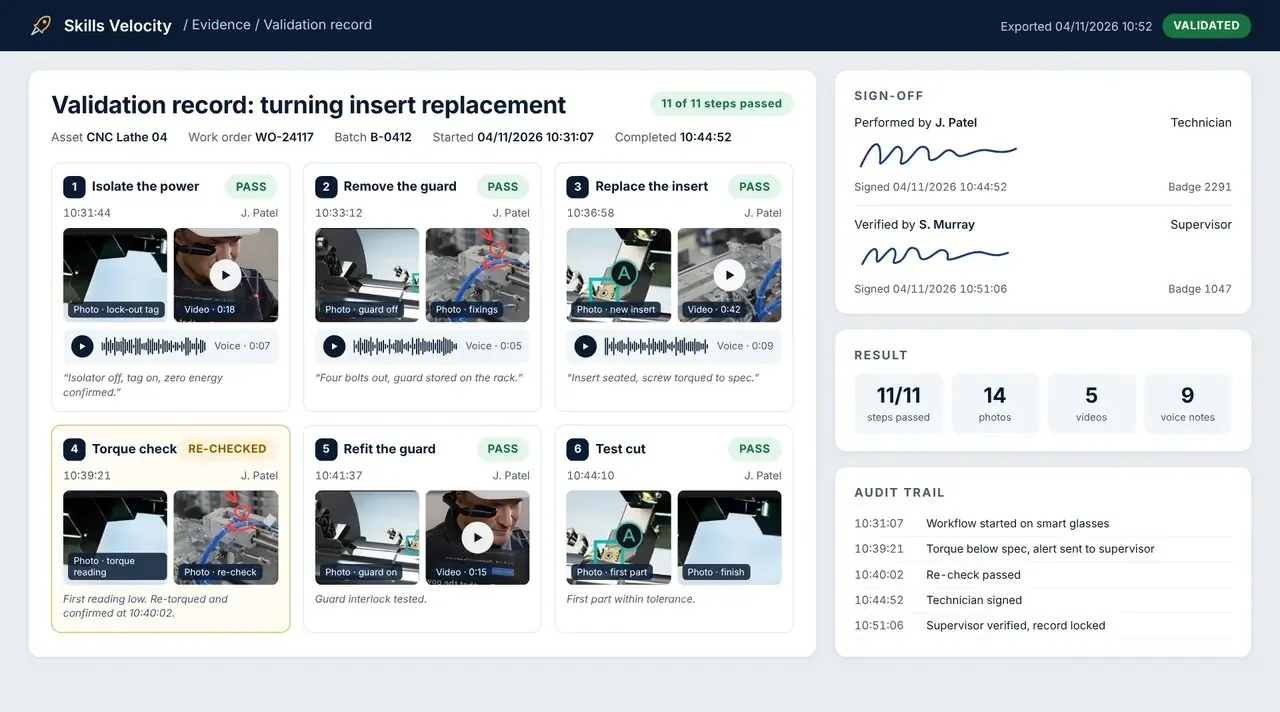
The record supports your evidence when a customer asks what you changed after a deviation. For what that record should hold at an audit, see operator competence records for ISO 9001 audits. If missed steps and lost batches are the wider worry, start with the problems we solve.
Next step
Pick the one step that causes most of your rework, and see it guided:
- Book a demo. Bring that procedure and we will turn it into guided, tracked steps while you watch.
- Send your SOP, see it play. Email mark@skillsvelocity.ai. A redacted or non-sensitive example is fine.
Frequently asked questions
How do I reduce rework caused by human error in manufacturing?
Trace each rework event to the step where it started, then name the type of error. Mistakes need training on a clear, current procedure. Slips and lapses need guided steps and checks at the point of work. Shortcuts need a method that is quicker to follow than to skip.
Why does retraining not stop repeat rework?
HSE says slips and lapses on familiar tasks cannot be eliminated by training, though better design can make them less likely. Retraining fixes gaps in what people know. Most repeat rework comes from missed or out-of-order steps on busy shifts, which need guidance at the step itself.
What is the difference between rework and scrap?
The American Society for Quality defines rework as the correction of defective material or errors, and scrap as defective product that cannot be repaired, used or sold. Both are internal failure costs, found before the product reaches the customer.
How do I find the root cause of rework on a production line?
Record the procedure step and version for every rework event, not just the defect. Ask the operator what happened at that step. Sort one quarter’s records by step and cost, and fix the few steps that carry most of the bill first.
Can digital work instructions reduce rework?
They can, when they put the current method at the point of work and advise people before they skip a check. Step-by-step video followed hands-free reaches the slips and lapses that classroom training misses, and the step record shows where rework still starts.
Where should we start if rework is costing us now?
Start with the one step that costs the most rework. Film your best person doing it, approve the steps, and guide operators through it. Compare the rework on that step for the next quarter, then move to the next step on the list.